
A comprehensive rehabilitation programme post operatively has been developed to improve your mobility and strength. Its purpose is to help you return to your normal activities as soon as healing allows. Follow up physiotherapy sessions can help progress your exercises, however you must take responsibility for completing the exercises at home.
ANATOMY OF THE KNEE
The knee is a hinge joint that receives support from the ligaments, menisci, cartilage and muscles. The patello-femoral joint (PFJ) is made up of the patella (kneecap) and the trochlea (the groove in the femur that the kneecap travels in). The undersurface of the patella is covered with articular cartilage, as is the trochlea. The PFJ can be traumatically injured (usually patella dislocation/subluxation), or can be subjected to excessive compressive forces due to muscle imbalance or overload leading to overuse injury (PFJ syndrome).
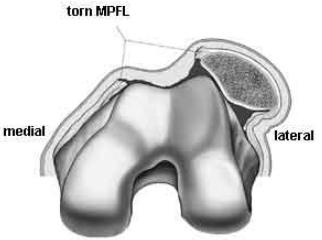
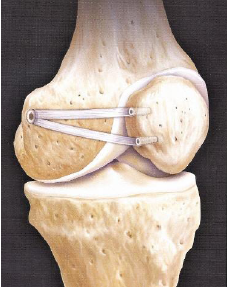
Several types of operations are used for patients who experience recurrent patella dislocation or persistent patella instability symptoms despite physiotherapy. The type of operation performed depends on the individual factors affecting each patient, sometimes a combination of operations is required. The most commonly used stabilisation procedure is a medial patello-femoral ligament (MPFL) reconstruction.
Dislocated patella / Tear of the MPFL
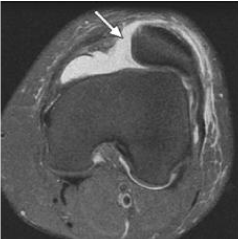
MRI Scan of Dislocated Patella
Medial Patello-Femoral Ligament (MPFL) Reconstruction
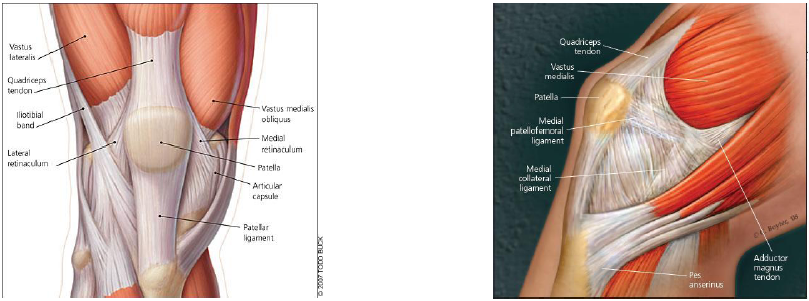
Muscles
- Quadriceps – the large muscle on the front of the thigh. A very important component of the quads muscle is the VMO – this is found on the inner thigh just above the knee cap (patella). It helps provide stability to the patella.
- Gluteal muscle group – this muscle group is made up of three muscles around the buttock. The gluteals play a major role in supporting the lower limb during all weight bearing activities.
Swelling
Post operatively, you may have considerable swelling surrounding your knee. It is crucial to reduce the swelling. Swelling impedes both your healing and mobility. Tips to decrease swelling:
- Wearing Tubigrip to support the knee during the day (do not sleep with Tubigrip on).
- Elevate your leg as much as possible.
- Ice your knee for 15–20 minutes, 3–4 times a day. More if you have just exercised or your knee is hot and swollen.
Patella Stabilisation Surgery Functional Activities Timeline
Please be aware that this timeline is a guide only. Everybody’s rate of healing differs and you may progress faster or slower than indicated.
Please feel free to call us at Body Logic Physiotherapy if you feel you are not progressing as well as you should be.
Weight bearing as tolerated. Begin walking with use of the crutches, easing off them as your pain allows.
Stationary bike riding as soon as able with no resistance. Begin doing only 10 minutes at a time, increasing time to 20 minutes. Ice your knee before and after.
See your physiotherapist at 1–2 weeks after your surgery.
Keep up with your rehab program as indicated by your physiotherapist.
Gently increase the resistance on the stationary bike as your pain allows.
Begin aquatic physiotherapy program designed for you by your physiotherapist. At 2–4 weeks, as long as wound healing has been achieved, begin swimming. Use a pool buoy in between your legs and do not kick. This will begin to improve your cardiovascular fitness and upper body strength.
Commence jogging in straight lines on the flat at 6 weeks. Start with a walk/jog program each day. Increase very gradually if there is no increase in pain or swelling.
Commence riding on the road at 6 weeks.
Strength and agility exercises will progress.
Progressively commence sport specific activities guided by your physiotherapist. Return to training and participating in skill exercises.
Low impact step aerobics classes can be commenced as indicated by your physiotherapist.
(3 Months)
Follow your physiotherapist’s guidelines for return to sport modifications.
Patella Stabilisation Surgery
Stage 1 (0–2 Weeks)
Goals
-
Control Swelling
- REST
- ICE – 15 to 20 minutes, 4 times per day
- COMPRESSION – Wear Tubigrip during the day
- ELEVATE – rest as frequently as you can with your leg up on a bed/couch
-
Mobility
- Achieve correct gait, FWB, if pain allows without crutches.
-
Exercises
- Achieve full passive extension (straighten out flat).
- Achieve full flexion (bending of the knee) – may be limited by swelling.
- Active strengthening begins with gentle contractions of quadriceps, and progresses to weight bearing contractions by day 7.
Exercises
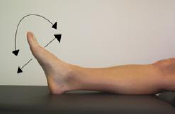
Ankle Mobility
Position: Sitting or lying
- Move ankle up, down and in circles.
- Repeat 10 times, every hour.
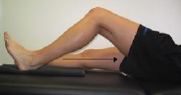
Knee Flexion
Position: Sitting or lying
- Gently bend your knee by sliding your heel towards your bottom as far as comfortable.
- Slowly straighten out.
- Repeat 10 times.
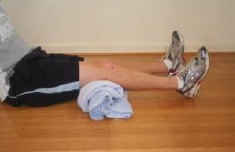
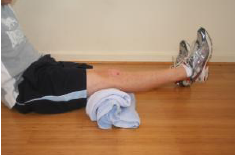
Towel Knee Extension
Position: Sitting
- Roll up towel and place under knee.
- Squeeze inner quads muscle and straighten knee, then slowly lower.
- Repeat ____ times per set.
- Do ____ sets per session.
- Do ____ sessions per day.
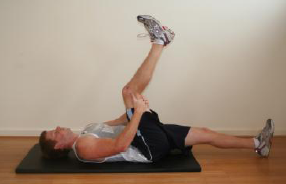
Hamstrings Stretch
Position: Lying
- With hands behind knee, pull knee towards chest until a comfortable stretch is felt in hamstring.
- Hold ____ seconds.
- Repeat ____ times per set.
- Do ____ sets per session.
- Do ____ sessions per day.
Exercises
Continue Weeks 0–1 exercises as well.
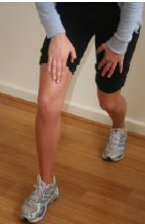
Standing VMO Activation
Position: Standing
- In step standing position, squeeze VMO then transfer weight onto front leg.
- Repeat ____ times per set.
- Do ____ sets per session.
- Do ____ sessions per day.
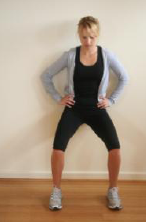
Wall Squats
Position: Standing
- With feet shoulder width apart and knees in line with toes, move into ½ squat and hold.
- Hold ____ seconds.
- Repeat ____ times per set.
- Do ____ sets per session.
- Do ____ sessions per day.
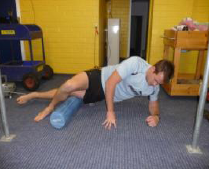
Foam Roller
Position: Side lying
- Laying on top of foam roller.
- Roll out the tight musculature along the outside thigh between the hip and knee.
- Slowly roll up and back 20 times.
- You can change the angle of the body to target different tight areas of the muscle.
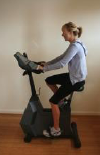
Stationary Cycling
- Start with 5 minutes on NO RESISTANCE and progress time as your pain allows.
- Ice your knee before and after each cycling session.
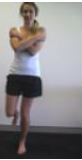
Standing Balance
- Aim to keep both your ankle and knee as still as possible.
- Aim for 30 seconds and then progress through eyes open, eyes shut and pillow once this is achieved.
- Aim for 10 minutes a day of balancing.